


Neuralgia: Why the Pain Happens and What Actually Helps
If a normal conversation, a bite of food, or even a light touch on your skin can trigger a sudden, stabbing pain, you may be dealing with neuralgia. Here's what it is, why it happens, and which treatments — including electrotherapy — can help today.

Table of Contents
-
What neuralgia is
-
What causes it
-
Symptoms to watch for
-
The most common types
-
When to see a doctor
-
How it's diagnosed
-
Modern treatment options
-
The role of electrotherapy
-
Prevention
A Real Story
Vladimir an engineer on the MESOFORM team who works on developing the device, experienced a flare-up of trigeminal neuralgia himself. A sudden, sharp shooting pain hit his temple, his eye began watering heavily, his eyelid drooped, and the pain was so severe it stopped him from working or going about his day — his face was visibly twisted from the pain. After two sessions with MESOFORM, the pain was gone, the watering stopped, and his eye and face returned to normal. A genuinely remarkable result.
What Is Neuralgia?
Neuralgia is pain that runs along a nerve, caused by irritation, inflammation, or compression of that nerve. Unlike muscle or joint pain, it typically feels sharp, burning, or shooting — and can strike even without any physical strain.
It can affect almost any nerve in the body, but the most common types involve the trigeminal nerve, the intercostal nerves, the occipital nerve, and the sciatic nerve (sciatica). The exact symptoms and how intense they are depend on which nerve is affected and what's causing the problem.
Neuralgia is often triggered by exposure to cold, injury, spinal conditions, inflammation, or prolonged pressure on nerve structures. Catching it early and getting the right treatment goes a long way toward reducing pain, protecting your quality of life, and avoiding complications down the line.
What Causes Neuralgia
Neuralgia develops when a nerve is irritated, inflamed, or compressed — sometimes gradually, sometimes seemingly out of nowhere after a specific trigger. Pinning down the cause is the key to choosing a treatment that actually works. The most common causes include:
-
exposure to cold;
-
injury or damage to nerve fibers;
-
spinal conditions;
-
osteochondrosis (degenerative spinal disc disease);
-
herniated discs;
-
infections;
-
inflammatory processes;
-
prolonged physical strain;
-
metabolic disorders;
-
diabetes.
Neuralgia can also show up after an injury or surgery — for more on recovering in those cases, see our article "Rehabilitation After Injury."
Symptoms of Neuralgia
How neuralgia shows up depends on which nerve is affected, but pain is always the defining symptom. For some people it comes and goes; for others, it's constant and takes a real toll on daily life.
Sharp or burning pain. Often described as sudden, shooting, or burning — attacks can flare up with movement, coughing, sneezing, or even a light touch to the skin.
Numbness and tingling. The area served by the affected nerve may feel tingly, hot, or temporarily numb — a sign the nerve fibers aren't functioning normally.
Heightened sensitivity. Even a gentle touch or a shift in temperature can trigger discomfort or pain. This is common across many forms of neuralgia.
Muscle weakness. With prolonged nerve irritation, muscles in the affected area can weaken, limiting movement.
Seeing a doctor as soon as symptoms appear makes it much easier to identify the cause quickly and start effective treatment.
The Most Common Types of Neuralgia
Neuralgia can affect a range of different nerves in the body, so how it shows up depends a lot on exactly where the problem is located. Some forms are far more common than others and can have a real impact on everyday activity and quality of life.
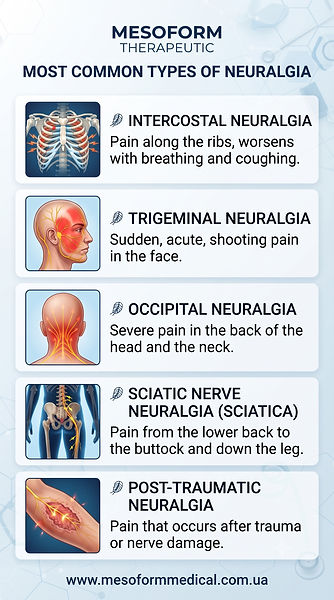
Trigeminal neuralgia
is one of the most painful forms. It causes sudden, sharp attacks of pain in the face, cheek, jaw, or eye, often triggered by talking, chewing, washing your face, or even a light touch to the skin.
Intercostal neuralgia
causes pain along the nerves between the ribs. Symptoms usually get worse with a deep breath, coughing, sneezing, or twisting the torso.
Occipital neuralgia
produces pain at the back of the head and neck, which can radiate into the shoulders and upper back, making everyday life noticeably harder.
Sciatica (sciatic nerve neuralgia)
happens when the sciatic nerve is irritated or compressed. The pain typically travels from the lower back through the buttock and down the leg, sometimes with numbness, tingling, or muscle weakness.
Post-traumatic neuralgia
develops after an injury, surgery, or long-term pressure on a nerve. Timely treatment and proper rehabilitation matter a lot here — read more in "Rehabilitation After Injury.
When to See a Doctor
Neuralgia pain can seriously disrupt daily life. Some episodes are short-lived, but pain that's persistent or intense is a good reason to see a specialist.
You should see a doctor if:
-
the pain doesn't go away after a few days;
-
attacks are becoming more frequent or more intense;
-
you notice numbness or weakness in your limbs;
-
the pain is disrupting your sleep or daily activities;
-
symptoms started after an injury;
-
you notice changes in sensation or mobility.
Getting diagnosed early makes it much easier to find the cause and choose the most effective treatment. If lower back pain is also part of the picture, it's worth reading "Lower Back Pain: Causes, Symptoms and Treatment."
How Neuralgia Is Diagnosed
Diagnosis starts with a conversation about your symptoms and a clinical exam. The doctor looks at where the pain is, what it feels like, how long it's lasted, and what tends to trigger or worsen it.
To confirm the cause, your doctor may also use:
-
a neurological exam;
-
X-rays;
-
MRI (magnetic resonance imaging);
-
CT (computed tomography);
-
electroneuromyography;
-
lab tests.
A thorough workup helps rule out other conditions and points to the treatment approach most likely to work.
Modern Approaches to Treating Neuralgia
Treatment for neuralgia depends on the cause of the disease, the location of the affected nerve, and the severity of the symptoms. The main goal of therapy is to reduce pain, eliminate factors that cause nerve irritation, and restore the patient's quality of life.
A modern approach to treating neuralgia may include:
drug therapy;
physiotherapy procedures;
therapeutic physical education;
massage;
manual therapy;
lifestyle correction;
rehabilitation programs.
In cases where neuralgia is associated with spinal diseases, injuries, or prolonged compression of nerve structures, comprehensive recovery and elimination of the underlying cause of pain play an important role.
To achieve the best result, treatment should be selected individually, taking into account the characteristics of each patient.
The Role of Electrotherapy in Neuralgia
Electrotherapy is a widely used physical therapy method as part of a broader approach to treating neuralgia. Under a specialist's guidance, it can help ease pain, support local blood flow, and aid tissue recovery.
Modern electrotherapy techniques target the areas where the affected nerves run, helping reduce discomfort and improve quality of life. This can be especially useful for chronic pain and during recovery from an injury.
MESOFORM THERAPEUTIC brings modern electrotherapy into a compact, at-home format, so you can do sessions in your own space without needing regular visits to a physical therapy clinic.
Neuralgia sometimes follows an injury or shows up during recovery — for more on modern rehabilitation approaches, see "Rehabilitation After Injury."
Preventing Neuralgia
Prevention is about lowering the risk of nerve irritation or damage in the first place. A few consistent habits go a long way toward keeping your nervous system healthy and cutting your odds of a painful flare-up.
The main things that help:
-
avoiding exposure to cold;
-
staying reasonably physically active;
-
paying attention to posture and spinal health;
-
treating inflammatory conditions promptly;
-
taking steps to avoid injury;
-
balancing work and rest;
-
keeping up with regular check-ups.
A healthy lifestyle and paying attention to your body are two of the best ways to lower your risk of neuralgia and other nervous system conditions.